What Does „Stodgy” Mean on Bake Off? A Guide to British Baking Terms
Stodgy
Every new season of the British culinary television spectacle brings a defined set of expectations for attentive viewers. We prepare to see complex desserts and ambitious architectural projects disguised as cakes. Inevitably, we witness at least one contestant whose future depends entirely on Paul Hollywood extending his hand for a handshake. We are also accustomed to hearing lexical terms that do not always translate easily across the Atlantic. This creates an amusing linguistic barrier between the two shores.
Latest news
 Trader Joe’s First‑Time Shopper Guide: Must‑Try Items
 Panda Express vs P.F. Chang's: Which Orange Chicken Is Healthier?
 Prosciutto Elevates the Classic Grilled Cheese Sandwich
 Costco Frozen Shrimp Rivals Steakhouse Appetizers
British patisserie possesses its own distinctive language. It is often more captivating than its American equivalent. In this universe, a cake can be described as „stodgy,” „claggy,” or „craggy.” The word „biscuit” does not necessarily mean what we usually imagine. Furthermore, the term „pudding” seems to function without clear semantic limits. Add to this the show’s permanent obsession with soggy bottoms in baked goods. This recurring topic has become almost a symbol of the format.
With the launch of the new broadcast campaign, which includes a new jury member, it is time to refresh our knowledge of British baking vocabulary. Here is a detailed explanation of the real meanings behind these seemingly strange but essential terms for understanding debates inside the competition tent.
Claggy
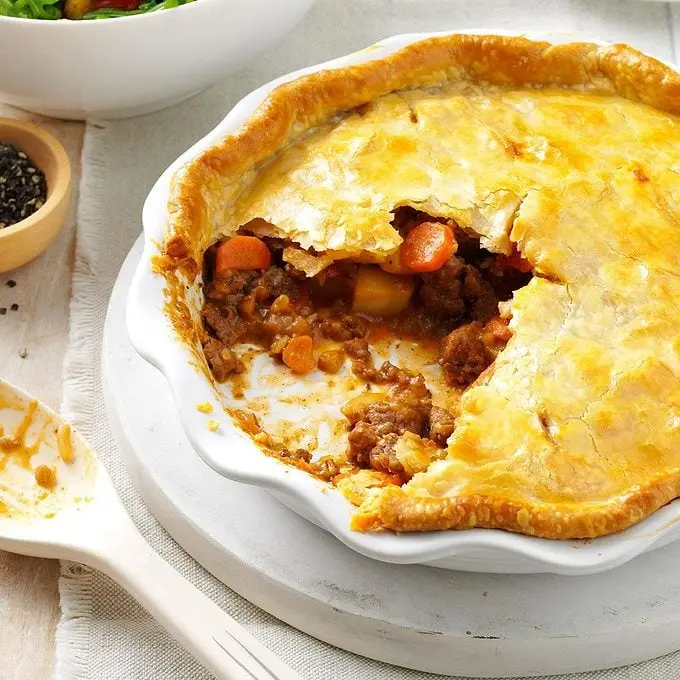
If Paul Hollywood hears you call your cake „stodgy,” do not expect a warm embrace. A pastry product classified this way is excessively heavy and dense. It lacks the light, airy texture it should have. Imagine a sponge cake that feels as solid as a door threshold rather than a refined dessert.
This term is not necessarily an insult outside the competition tent. A hearty meal, such as a rich game dish, can be described as „stodgy” without anyone taking offense. However, after spending three hours trying to produce a delicate sponge, hearing this adjective is not exactly what you want to hear.
The terms „stodgy” and „claggy” are close relatives, but they cannot be used interchangeably. „Claggy” describes an unpleasantly sticky texture. Specifically, it refers to something that sticks to the roof of your mouth.
Craggy
Paul Hollywood and former judge Prue Leith have already addressed this distinction. They used peanut butter as a typical example of something that is „claggy.” A heavy cake might be considered „stodgy,” but if it sticks to your mouth like edible glue, you have entered „claggy” territory.
„Craggy” sounds like a term you would use to describe a particularly unpleasant British school headmaster. However, in the context of patisserie, it indicates a rough and irregular surface.
Pudding
Think of the rugged exterior of a rustic loaf of bread or the uneven peaks of a scone. Unlike „stodgy” or „claggy,” „craggy” is not necessarily a criticism. Sometimes, a pastry product should look slightly rough at the edges. Not everything needs to come out of the oven perfectly smooth.
Americans have a fairly specific understanding of the word „pudding.” It comes in chocolate, vanilla, and occasionally butterscotch varieties. It is eaten with a spoon. The British have other perspectives.
„Pudding” can refer to dessert in general. However, it can also describe a specific type of food. This food can be steamed, baked, sweet, or savory. Sticky toffee pudding is a sponge cake served with toffee sauce. Meanwhile, Yorkshire pudding is a savory batter, traditionally served with roast beef.
Jelly
Then there is black pudding, which is actually blood sausage. I am beginning to believe that the British are simply playing a game to see how far they can push this concept.
In the UK, „jelly” is what Americans call Jell-O. It is a sweet, wobbly dessert made with gelatin. What we call „jelly,” meaning fruit preserve that pairs well with peanut butter, is generally called „jam” on the other side of the ocean.
It is important to understand this difference before finding yourself in a situation where you wonder how to get a jar of Smucker’s that wobbles.
Biscuit
Here, Anglo-American relations begin to deteriorate.
In Britain, a „biscuit” is generally what Americans call a „cookie.” It is usually a crisp item, such as shortbread. This is the type of biscuit you would serve next to a cup of tea.
Soggy bottom
This does not mean that the British do not have „cookies.” They do, but the word generally describes something larger and softer than a traditional biscuit. It often contains chunks of chocolate.
What the British do not understand is the American biscuit. It is fluffy and rich in butter. Ordering „biscuits and gravy” on the other side of the ocean would require a fairly extensive explanation. I am not sure it would improve diplomatic relations.
Few phrases have done more for culinary-British innuendos than „soggy bottom.”
Bap
Unfortunately for the pastry chef receiving this critique, it refers to a pastry base that did not bake properly. Alternatively, it absorbed too much moisture from the filling. Instead of a crisp, well-baked crust, the bottom of a pie or cake is wet and soft.
It is a legitimate technical issue. However, the show’s hosts have never been very willing to let this aspect stand in the way of a joke.
A „bap” is a soft roll, often used for sandwiches. Depending on the region of the UK where you are, you may encounter other regional names for similar rolls. These include „barm” and „cob.”
Content written by Lindsay Parrill for fancy-meals.com editorial team, AI-assisted.